Blog
From Chat to Ambient: the interface war after the AI breakthrough
“Using AI” started as a destination: open a chatbot, type a question, hope you were specific enough. It was magical, and also oddly exhausting. The blank prompt box turns every task into a writing assignment.
This week’s most revealing updates aren’t about a sudden leap in raw capability. They’re about interaction. AI is being pushed out of the chat window and into the places where people already spend their attention: the phone UI, the wearable layer, and the tools of work. That matters because interface changes decide who owns distribution, who gets the default slot, and who gets to set the rules.
The first phase of generative AI was a model race. The next phase is an interface war.
The chat box has a ceiling
Chat is an incredibly efficient way to ship a new capability, but it’s a weak long-term moat. When the product is mostly an input field and a stream of text, differentiation is subtle. You can add memory, voices, “agents,” and file uploads, yet for many users it still feels like the same box with a different logo.
The deeper issue is that chat makes the user translate real life into prompts. If the task is small—summarize this, draft that—it’s fine. If the task is continuous—shopping, scheduling, navigating, triaging messages, coding—it’s friction. The best assistant isn’t the one that answers best; it’s the one that reduces coordination work.
So the winning interaction pattern is shifting in three directions.
First, from “answer” to “do,” but with supervision: the assistant runs a sequence while you can interrupt.
Second, from “tell it everything” to “it already knows the situation,” by reading on-screen context and app state.
Third, from “go to the AI app” to “AI shows up inside the moment,” as a lightweight layer rather than a separate destination.
You can see these shifts landing—almost simultaneously—on phones, faces, and developer workflows.
The turn: intelligence moves into the seams
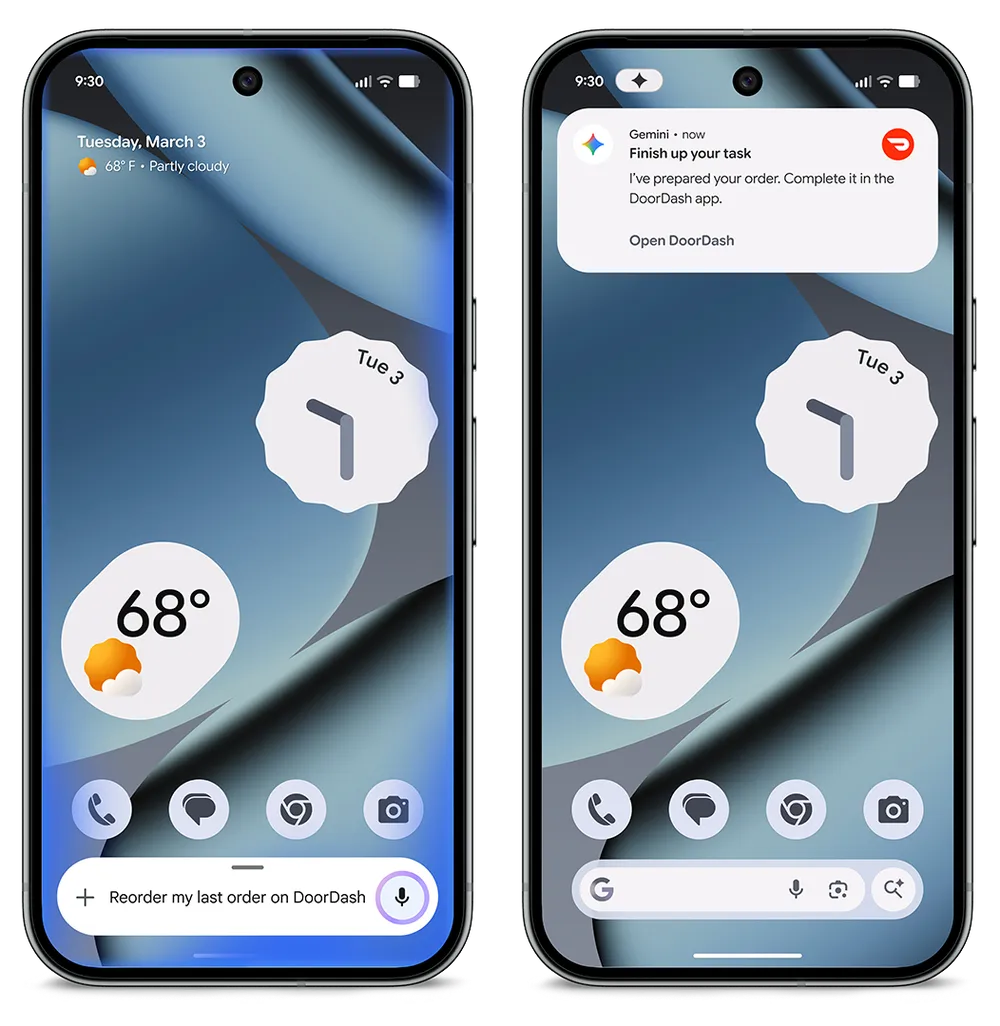
Google’s March Pixel Drop is a clear example of AI becoming a contextual layer rather than a separate app. Circle to Search expands into multi-object recognition, letting you circle an entire outfit or scene and explore multiple items in one go. That’s not just “search is better”; it’s a reduction in the number of steps between noticing and deciding.
More telling is how Gemini is framed. The update emphasizes offloading tasks “within apps” and surfacing suggestions inside chats via Magic Cue, so the assistant appears where intent is already forming instead of demanding a context switch (Source: Google Pixel Drop, Mar 3 2026: https://blog.google/products-and-platforms/devices/pixel/march-2026-pixel-drop/).
At Mobile World Congress, the same pattern shows up in hardware. CNET’s hands-on with Alibaba’s Qwen smart glasses is interesting less because the glasses are perfect—they’re early—and more because the default interaction is hands-free and situational. Wake word, microphones, camera, a minimal heads-up display: translation, turn-by-turn directions, quick “what am I looking at?” queries. It’s a reminder that the phone isn’t the only place an assistant can live once models can handle messy, real-world requests without collapsing (Source: CNET, Mar 2026: https://www.cnet.com/tech/mobile/alibaba-launches-qwen-ai-smart-glasses-at-mwc-2026/).
Then there’s work, where interface change tends to arrive as workflow change. TechCrunch reports Anthropic rolling out a voice mode for Claude Code, activated with “/voice,” turning coding assistance into spoken steering: “refactor the authentication middleware.” That sounds small until you remember how much of professional work is a loop of reading, deciding, and nudging tools. Voice doesn’t just save keystrokes; it changes tempo. It makes the tool feel ever-present rather than summoned (Source: TechCrunch, Mar 3 2026: https://techcrunch.com/2026/03/03/claude-code-rolls-out-a-voice-mode-capability/).
Taken together, these are not random features. They’re a coherent move away from explicit prompting and toward implicit intent.
Payoff: context becomes the moat
Once AI is ambient, the advantage shifts to whoever controls the “moment of need.” That’s why OS-level assistants are strategically bigger than standalone apps, and why wearables are fought over even before they’re mainstream. The company closest to the user’s attention gets to choose which model to call, which tools to authorize, and which ecosystem partners get to plug in.
Ambient assistants also force a practical reckoning. If an assistant is going to sit in your chats and on your face, latency and reliability stop being technical footnotes. Privacy stops being a settings page. The assistant becomes something like a utility: always on, often listening, occasionally wrong in ways that feel personal.
That’s also why infrastructure and partnerships start to matter again. A report this week suggests Apple has explored deeper reliance on Google’s cloud to run a Gemini-powered Siri overhaul, potentially to meet performance and scale needs under stricter privacy expectations (Source: India Today, Mar 3 2026: https://www.indiatoday.in/technology/news/story/apple-to-supercharge-siri-with-gemini-google-servers-may-help-speed-up-apple-intelligence-2876820-2026-03-03). Whether every detail holds up isn’t the point; the direction is. Ambient AI is expensive, operationally hard, and politically sensitive.
For users, the upside is obvious: fewer tabs, less copy-paste, fewer “restate the context” moments. For businesses, the bigger change is that software interaction becomes less about operating interfaces and more about steering outcomes. That revalues skills. “Prompt engineering” is already fading as a concept; what matters is judgment—when to delegate, when to demand sources, when to lock down permissions, and how to design workflows that assume the assistant will be helpful and occasionally wrong.
The chat box won the first phase because it was the fastest way to ship a new interface to a new capability. But “fastest to ship” rarely equals “best to live with.” The next winners will make AI feel less like a product you open and more like a reflex you rely on—quiet, embedded, and available in the seams of everyday work.