Blog
Physical AI Leaves the Demo Stage
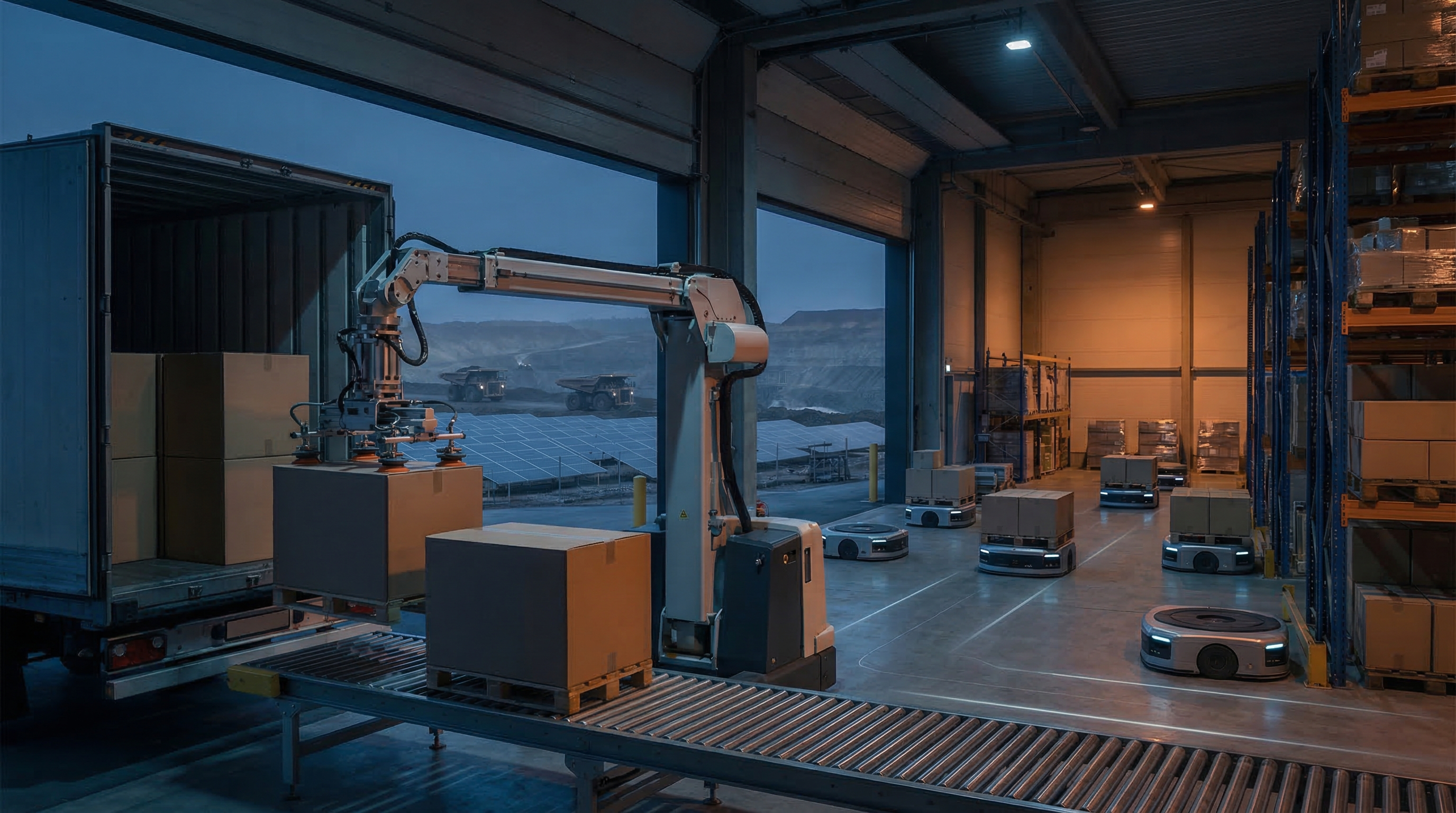
For the last few years, most AI stories lived on screens.
Text, images, code, search, customer support, note taking. Useful categories, large categories, sometimes category-defining categories. Still, they all shared the same basic property. The machine was handling symbols.
Now a more consequential class of company is stepping into view. Not the humanoid companies that dominate headlines, but firms going after the old hard industries that still run the world. Food production. Mining. Transport. Warehousing. Welding. Construction. Field operations. Industrial inspection.
This is where the next serious wave is forming.
The cleanest signal came from Atoms, Travis Kalanick’s newly unveiled company. Strip away the manifesto language and the core thesis is sharp. Atoms is not making a case for robots that look like people. It is making a case for specialized systems that do productive work in sectors where motion, material, and machinery determine the economics.
That framing matters because it names the real opportunity. Most of the economy still depends on moving heavy things through space, extracting raw materials, converting them into useful products, keeping assets running, and getting output where it needs to go. Software transformed information work first because information was easy to instrument. The physical world was slower to yield.
That is changing.
A new generation of companies is now treating physical operations as a computation problem. Sense the environment. Model it. Decide inside it. Act in it. Learn from the loop. Repeat.
That is what people mean, or should mean, when they talk about Physical AI.
Atoms says the quiet part out loud
Atoms is interesting less because it has already revealed every product detail, and more because it states the industrial thesis plainly.
Its focus areas are food, mining, and transport. Its language revolves around “digitizing the physical world” and building “gainfully employed robots.” That phrase is better than most of the category’s marketing. It points to something many founders in this space understand instinctively.
A useful robot is not a robot with human posture. It is a robot with a budget line.
That is why Atoms draws such a hard distinction between humanoids and specialized machinery. In a home, where tasks are varied, low-volume, and bounded by spaces designed around human bodies, a more general form factor may make sense. In an industrial kitchen making a thousand pancakes an hour, or on a mine site moving material through a tightly constrained route, a humanoid is often the wrong answer. The right answer is a purpose-built system designed for throughput, reliability, serviceability, and unit economics.
That argument extends well beyond Atoms.
Once you start looking for it, a broad field of companies appears that are doing exactly this.
The interesting companies do not start with a robot. They start with a bottleneck
This is the pattern.
The best Physical AI companies are not trying to solve “general robotics.” They are attacking a very specific operational choke point that is painful, repetitive, expensive, hard to staff, and important enough for someone to pay to fix.
A few good examples:
Mytra is focused on moving and storing material. That sounds almost insultingly basic until you remember that moving and storing material is one of the most common tasks in industry. Mytra’s system combines bots, software, and dense storage cells to create a software-defined warehouse layer built around routing, perception, redundancy, and flexible inventory placement.
Path Robotics is aimed at welding, where quality variation, labour scarcity, and throughput pressure all collide. Its message is not “look at our robot.” It is “we can automate welding on real-world parts, not perfect demo parts.” That is the sort of sentence operators notice.
Carbon Robotics built an AI-guided laser weeding system that identifies crops versus weeds in real time and eliminates weeds with sub-millimetre precision. It goes after one ugly farm problem with a combination of vision, models, robotics, and economics that can beat hand labour and chemical-intensive alternatives.
Agtonomy embeds autonomy into off-road agricultural equipment so growers can automate routine work using machinery and brands they already trust. That is a strong go-to-market instinct. It lowers behavioural friction instead of asking the customer to become a robotics lab.
Pickle Robot automates trailer and container unloading, one of the least glamorous jobs in logistics and one of the most physically punishing. The company’s line that machines should do the heavy lifting while people handle problem solving is blunt and credible because the task itself is so clear.
Gecko Robotics uses robots that climb, crawl, swim, and fly to inspect critical infrastructure, then turns that inspection data into a live operating picture for maintenance and planning. This is not robotics as spectacle. It is robotics as industrial observability.
Built Robotics has spent years automating construction equipment and has found especially strong footing in utility-scale solar, where repetitive site work, labour bottlenecks, and schedule pressure make autonomy economically attractive.
Put these together and the pattern becomes obvious. Physical AI is not one monolithic market. It is a growing set of vertical businesses that each combine hardware, software, control systems, data, and service around one industrial pain point.
That is also why the category feels as though it is appearing all at once. It is not one company emerging from stealth. It is the physical economy becoming legible to software company builders.
What makes these companies work
The common ingredients are clearer than the product categories.
1. They are built around hard ROI
The strongest companies in this wave can answer a simple question in one sentence.
What changes on the customer’s P&L if this system works?
Unload trailers faster. Increase storage density. Reduce injuries. Raise weld yield. Remove herbicides. Improve crop quality. Extend asset life. Accelerate solar deployment. Offset labour shortages. Increase equipment utilization.
That is a very different commercial posture from selling “AI transformation.” Buyers in these sectors do not care about abstract intelligence. They care about throughput, uptime, safety, quality, and margin.
This is one reason the category feels sturdier than many recent AI software startups. The customer pain is not speculative. It is already sitting in operating budgets.
2. They do not automate fixed scripts. They manage variation
Older industrial automation was often brittle. Great when the world behaved exactly as expected, miserable when the world did not.
The new class of systems is more ambitious. It still values reliability, but it combines perception, planning, and adaptation so the machine can work inside environments that are structured without being perfectly controlled.
This is the deeper shift.
Mytra simulates routes and adapts movement in real time. Carbon Robotics uses a large plant model trained on a huge corpus of labeled plants so it can distinguish crop from weed across real fields. Gecko fuses robotic inspection with predictive software so operators can act on the state of assets rather than on rough inspection intervals. Path is explicit that its system is designed for real-world parts, not ideal ones.
That is the move from automation to operational intelligence.
3. They are full-stack because reality forces them to be
Pure software let founders pretend the world ended at the API. Physical AI does not allow that luxury.
To make these systems work, you need a stack that spans sensing, controls, compute, data pipelines, model training, simulation, deployment tooling, maintenance, fleet management, safety, and field operations. In many cases you also need deep knowledge of the customer workflow and the ability to integrate with incumbent equipment.
That makes these companies harder to build. It also makes them more defensible.
The moat is not usually “our model benchmarks better.” The moat is that the company understands a difficult environment in painful detail, has the data from real deployments, and can keep the system working after the sale.
4. They pick constrained environments first
This may be the most underrated strategic choice in the entire category.
A field row is constrained. A trailer dock is constrained. A weld cell is constrained. A solar site is constrained. A mine haul road is constrained. These are not trivial environments, but they are bounded enough for autonomy to become commercially useful before general-purpose robotics does.
That is why so many of the best companies in this space look narrow at first glance. The apparent narrowness is not a weakness. It is the reason they can get to reliable performance, real data, and repeated deployments.
Why this is happening now
The timing is not mysterious. Several curves have bent in the same direction.
The software stack finally became good enough
Robotics has always been held back by the gap between a controlled demo and a live deployment. That gap is now getting narrower.
Perception models are better. Simulation tooling is better. Synthetic data workflows are better. Edge compute is stronger and more affordable. The broader model ecosystem has made it easier to build systems that can classify, localize, predict, route, and recover under more real-world variability than older robotics stacks could absorb.
The point is not that the problem has been solved. It has not. The point is that the cost and difficulty of getting to a competent first deployment have moved enough to make more categories venture-buildable.
Labour pressure is forcing the issue
Many of the industries now attracting Physical AI startups have the same structural problem. The work is hard, repetitive, sometimes dangerous, and increasingly difficult to staff at the required quality level.
Welding is the obvious example. So are trailer unloading, specialized farm tasks, heavy construction workflows, and industrial inspection in hazardous environments. In these settings, automation is not a nice story for the annual report. It is an operational response to scarcity.
When labour gets harder to find and harder to retain, machines that can handle the repetitive share of the work become easier to justify.
The industrial economy is back in focus
There is also a larger macro story running underneath all of this.
Energy transition, supply chain resilience, domestic manufacturing ambition, infrastructure renewal, and defense readiness are all pulling attention back toward the physical base of the economy. Rich countries want more industrial capacity, more reliable logistics, and more resilient infrastructure. That cannot happen through slide decks alone.
It requires better tools for making, moving, and maintaining things.
Physical AI fits naturally into that agenda. In some sectors it will be bought as productivity software. In others it will be bought as industrial policy by another name.
Customers will now buy software-plus-machine products
Another change is less glamorous but just as important. Customers are more willing than they once were to buy outcomes wrapped in hardware, subscriptions, service contracts, and continuous software improvement.
That matters because it gives startups room to wedge in.
They do not need to replace an entire operating model on day one. They can enter through one painful workflow, prove value, deepen the data loop, and expand from there.
That is how real industrial categories are born.
The ethos is different this time
One reason this category feels fresher than older robotics booms is tone.
The strongest companies are not selling a fantasy of replacing the human world with chrome stand-ins. They are selling better economics for systems that already matter.
Their worldview is practical.
Humans should handle supervision, edge cases, and judgment. Machines should take the repetitive strain, the heavy lifting, the dirty work, and the precision task that benefits from consistency at scale.
Specialization is not seen as a compromise. It is seen as discipline.
Industrial data is not a by-product. It is the product.
Reliability is more valuable than novelty.
This is what makes Atoms a useful symbol for the moment even if its story is still early. It says out loud that the point is not robotics as theatre. The point is robotics as productive capacity.
That is a much more serious ambition.
Where this goes next
In the next few years, three things are likely.
First, the market will specialize before it generalizes. The winners will own categories like welding, unloading, crop care, inspection, material flow, or solar construction before anyone owns “general physical intelligence” in a commercially meaningful sense.
Second, the best companies will compound through data loops rather than device sales alone. The machine gets them onto the site. The learning loop is what makes the business harder to dislodge. Better models, better routing, better service, better prediction, better fleet orchestration.
Third, the real platform battle will move underneath the branded applications. Simulation layers, world models, robotics middleware, fleet control, safety systems, and edge inference stacks will become foundational infrastructure for the category. Some of the biggest winners may end up being the companies that make the whole field easier to build.
Why this matters
This matters because many of the biggest economic constraints are physical constraints.
Factories need skilled throughput. Farms need labour leverage and more precise input use. Infrastructure operators need to know what is failing before it breaks. Warehouses need fluidity. Construction and energy projects need speed. Mining and transport need safer, more autonomous operations.
If Physical AI delivers, even unevenly, it will not just create a few valuable robotics companies. It will raise the capacity of the systems that the rest of the economy sits on top of.
That is the real story.
The next generation of AI leaders may not be the companies with the slickest interface or the most entertaining demos. They may be the companies that can make a weld more consistent, a warehouse denser, a farm more productive, a mine safer, or a solar site faster to build.
That is not a side plot to the AI era.
It may be the part that lasts.