Blog
The Robots Are Already Building the Invisible Future
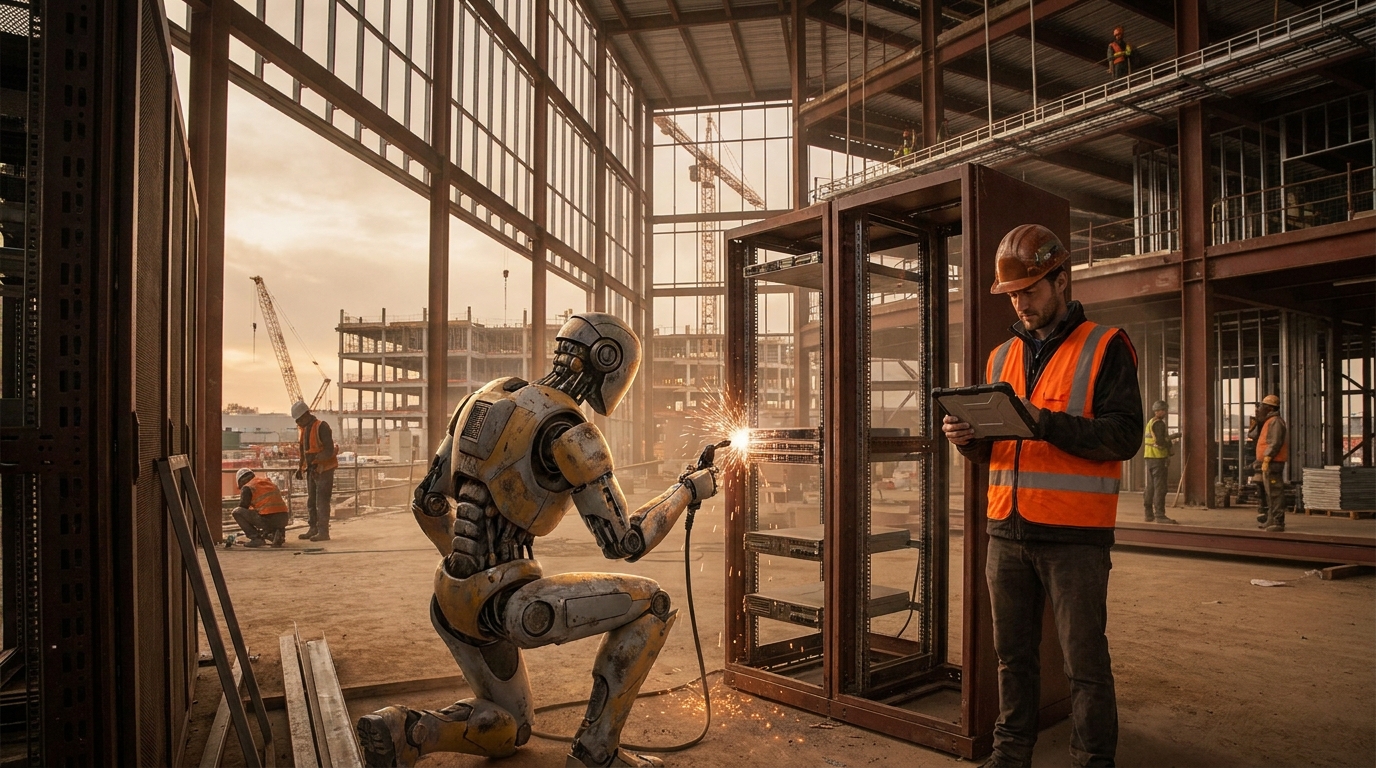
That company, reportedly code-named Roze, was unveiled just this week. It will deploy autonomous robots to construct server farms — and some insiders already want it public by late 2026. Let that sink in. A conglomerate that built its reputation on moonshot bets now thinks the safest, most lucrative near-term bet is literal robots laying the physical groundwork for AI infrastructure. The signal could not be louder.
The Labor Shortage Nobody Talks About Anymore
There is a strange consensus forming across every industrial sector I track: the human workforce is not coming back in the shape we need it to.
Forbes reported yesterday that U.S. industries still face millions of open roles in healthcare, manufacturing, and services. Costs are up. Expectations are higher. Capgemini's latest reindustrialization report flags a parallel story in Europe: greenfield factories are finally deploying AI, digital twins, and edge robotics at scale, but the real bottleneck is finding enough skilled workers to operate them.
So what happens? You stop trying to hire the same way. You change the shape of the job.
Japan Airlines is trialing humanoid robots for baggage handling at Tokyo Haneda right now, per a report from earlier this week. Unitree Robotics' machines are already pushing cargo onto conveyor belts on the tarmac. In Japan, where an aging population and shrinking workforce are colliding with surging travel demand, this is not a PR stunt. It is a structural necessity.
Numbers That Make You Sit Up Straight
Let me throw a few figures at you, because they tell a better story than any analyst deck could.
Construction robotics raised $1.36 billion in the first three quarters of 2025 alone, according to Zacua Ventures' 2026 report — up 125% from all of 2024. That is not a gentle upward curve. That is a cliff.
The global robotic arm market is valued at $18.25 billion this year and is on track to nearly double to $36.20 billion by 2035, per Precedence Research. These are the literal arms clamping, welding, and sorting inside almost every factory you interact with as a consumer, and their economics have crossed an inflection point where adoption is outpacing planning.
Perhaps most striking: a Chinese logistics center reported this week is running almost entirely on humanoid robots at 85% human-level efficiency, 24 hours a day, nonstop. No breaks. No shift changes. No holiday cover. I have seen those numbers disputed by skeptics, but here is the thing — even if the real figure is closer to 65%, or even 50%, the trajectory is unmistakable. These machines are learning assembly lines faster than we assumed possible two years ago.
Goldman Sachs analysts now project global humanoid robot demand at 30,000 units for 2026, with ramping acceleration into 2027. That sounds modest until you realize these robots are not being sold as novelties. They are being priced and deployed as capital equipment.
The Real Disruption Is Not What They Do
Here is where I think most commentary misses the point. The debate about whether robots "take jobs" is already obsolete. The companies deploying them at scale are not trying to fire people — they are trying to expand capacity in a world where hiring has stopped working.
Amazon cut delivery times by a quarter by operating the world's largest robotics fleet in its warehouses. Foxconn secured 15% cost savings by handing precision tasks like screw-tightening over to AI-infused robots, per Abdul Latif Jameel's analysis. FANUC just posted record net sales of ¥857 billion with operating margins above 21%. These are not labor-replacement stories. These are labor-extension stories. The robots fill the gap, and the humans move up the value chain.
The companies deploying robots at scale are not trying to fire people — they are trying to expand capacity in a world where hiring has stopped working.
The shift is not coming. It has been happening quietly for years, and 2026 is the year the noise finally matches the signal.
What Happens Next
If SoftBank is right, and autonomous construction robots become the default way we build the physical layer of AI, then demand for these machines becomes a self-feeding loop: more data centers need more robots, which power more AI, which demands more data centers. It is a flywheel, and we are not at the top of the curve yet.
My read? The next three years will not be about dramatic job losses or factory riots. They will be about quiet, relentless restructuring. Factories that were built around human shift patterns will get redesigned around continuous machine uptime. Warehouses will reprioritize floor space toward robot corridors. Entire categories of capital expenditure — forklifts, conveyor systems, even HVAC plans — will get rethought because the worker in the building no longer needs oxygen or lighting.
That is not dystopia. That is logistics.
The robots are already here. The only real question is whether your industry notices before your competitors do.