Blog
The Screen Is Becoming a Checkpoint
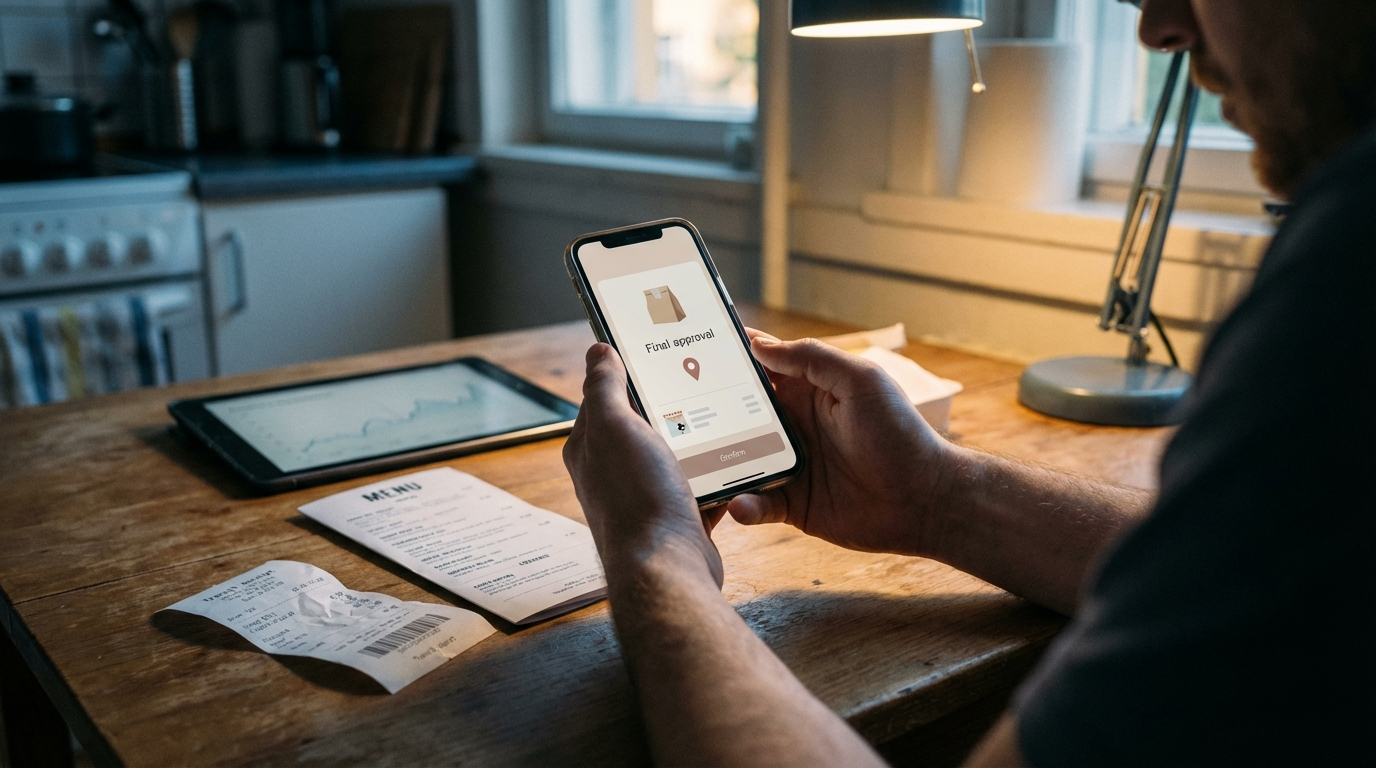
For most of the history of personal computing, the rule was simple: you drive, the machine responds. You tap the app, choose the menu, fill the field, press the button, and maybe repeat that dance a dozen times to achieve something boring and ordinary, like ordering dinner, booking a ride, understanding a lab result, or learning why a graph curves the way it does.
That choreography is starting to invert.
In the past three days, a cluster of announcements and reports has pointed to the same shift from different directions. Business Standard reported that Google’s Gemini task automation is rolling out in beta on the Galaxy S26, letting the assistant move through supported delivery and rideshare apps, fill in steps, and stop at the final confirmation. 9to5Mac wrote this week that ChatGPT and Claude are evolving from chatbots into interactive learning tools, turning explanations into visual modules, charts, and diagrams you can manipulate. U.S. News covered Microsoft’s new Copilot Health, which can assemble medical records and wearable data into a more tailored layer of guidance. And NVIDIA’s live updates from GTC 2026 are full of the same language: proactive assistants, agentic AI, physical AI, and systems that act continuously rather than wait passively for each command.
These are not isolated product tweaks. They are the outline of a new interaction model.
For decades, the interface was the place where humans translated intention into procedures. You did not tell the computer what you wanted in broad terms; you told it, step by step, how to get there. The app was a destination. The screen was a workbench. The workflow lived in your head.
Now the workflow is beginning to migrate into the software itself.
From clicking to commissioning
The most important detail in the Gemini story is not that the assistant can use apps on your behalf. It is that it pauses before the final confirmation. That sounds minor. It isn’t. It is the whole point.
What we are seeing is not the disappearance of the interface, but its promotion to a higher level of abstraction. The old interface asked: which button do you want to press next? The new one asks: what outcome are you trying to achieve, and what do you want to inspect before I commit?
That is a profound change.
If this pattern holds, apps become less like places you visit and more like endpoints an assistant can reach. The user no longer has to traverse every screen in person. Instead, the software can handle the procedural middle: open the app, enter the location, compare the options, build the cart, draft the chart, pull the records. The human stays in the loop at moments of judgment, not moments of navigation.
The same shift is visible in the updates to ChatGPT and Claude. As 9to5Mac notes, these systems are becoming less like answer vending machines and more like dynamic explanatory surfaces. A response is no longer just text; it can be something you manipulate, test, and refine. In other words, the model is not merely returning language. It is returning a working object.
That matters because text-only chat was always a transitional interface. It was powerful, but also awkward. Asking an AI to explain compound interest in paragraphs was useful. Asking it to show you how changing the rate or time alters the curve in real time is better. The same principle applies in health. Microsoft’s Copilot Health, as described by U.S. News, is not interesting because it adds more text. It is interesting because it tries to become an interpretation layer across records, wearables, and identity-verified access.
The screen, in other words, is turning into a checkpoint, a dashboard, and a review surface.
Not a cockpit for manual flying. More like mission control.
The real battle is over trust, not talk
This is the turn that a lot of AI commentary still misses. The question is no longer just whether models can talk fluently. Plenty can. The strategic question is where humans will allow them to act, what they will be allowed to see, and how much friction is required before people trust the result.
That means the next interface war may not be won by the smartest model in the narrow sense. It may be won by whoever designs the best permission system, the clearest audit trail, the most legible preview state, and the safest handoff between machine initiative and human consent.
The killer feature may be approval.
That sounds less glamorous than AGI, but it is probably closer to where value gets captured. If an assistant becomes the place where intent is expressed, then the companies underneath it start to look different. Apps become tools in a chain. Search becomes a background retrieval layer. Interfaces become thinner in some places and more consequential in others. Product teams have to think less about page flows and more about authority design: what should the system do alone, what should it suggest, what should it ask, and what should it never touch without an explicit nod?
There are obvious risks here. Delegated software can be wrong in opaque ways. It can over-assume. It can flatten nuance. In medicine, finance, education, and enterprise work, a smoothly worded mistake is often more dangerous than a clumsy manual process. That is why the human checkpoint matters so much. The future is not simply “AI does everything.” It is more likely “AI does the boring middle, and humans supervise the edges that carry cost, judgment, or liability.”
That is also why NVIDIA’s GTC framing matters. Once AI is described as proactive, always-on, and increasingly physical, the interface question stops being a software-design curiosity and becomes an economic one. If computers can watch, listen, infer, and act across digital and physical systems, then the bottleneck shifts from raw capability to acceptable autonomy.
And that is where the next decade of product design will be fought.
We will still open apps, just as we still sometimes type URLs. But increasingly, the ordinary experience of technology will not be operating software by hand. It will be commissioning tasks, reviewing what the machine proposes, and intervening when it matters. Less tapping through funnels, more managing competent but literal subcontractors.
That is a very different relationship with technology.
And it may arrive faster than we think, not because one giant breakthrough suddenly erases the old interface, but because a series of small changes quietly demotes it. One app hands off to an assistant. One chart becomes interactive. One medical record becomes narratable. One device becomes proactive.
Then, all at once, the old model feels strangely manual.